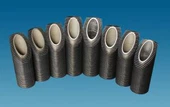
Duplex stainless steels are highly corrosion-resistant and can be strengthened through work hardening. These steel tubes contain a relatively high chromium content, typically ranging from 18% to 28%, and moderate to low amounts of nickel, typically between 1.5% and 8%. The exceptional corrosion resistance and impressive mechanical properties of duplex stainless steels are attributed to their chemical composition and the balanced, or "duplex," microstructure, which consists of roughly equal volumes of ferrite and austenite. This duplex nature means they exhibit characteristics of both austenitic and ferritic stainless steel. In most cases, duplex stainless steels are tougher than ferritic stainless steels, and their strengths can sometimes be double that of austenitic stainless steels.
Grade: S31803/S32205, S32750, S32760, S31500, 32001, S32003, S32304
Outside Diameter: 6mm-300mm
Wall Thickness: 1.0mm-12.7mm
Length: 1m-12m, or as required
Delivery Time: 30-70 days

The microstructure within duplex stainless steels consists of approximately 50 percent austenite and 50 percent ferrite. As a result, duplex products exhibit the physical properties characteristic of both ferritic and austenitic grades. Duplex stainless steels offer resistance against chloride stress corrosion cracking, a common issue in austenitic grades, and they also display improved resistance to localized corrosion. This stainless steel family boasts roughly double the yield strength of their austenitic counterparts, enabling the design of thinner gauge tubing. The higher hardness values contribute to enhanced wear resistance, particularly for high-precision tubes.
When compared to ferritic stainless steel, duplex stainless steel exhibits greater plasticity, ductility, improved resistance to intergranular corrosion, and enhanced weldability. It retains the same 475 degree brittleness as ferritic stainless steel and maintains a high level of thermal conductivity.
Duplex Stainless steel blends numerous advantageous characteristics of both ferritic and austenitic materials, resulting in a combination of high strength and excellent corrosion resistance. Thanks to their elevated levels of chromium, molybdenum, and nitrogen, along with their duplex microstructure, these steels deliver numerous advantages when compared to austenitic grades in the 300 series:
Exceptional resistance to stress-corrosion cracking.
The continuous utilization of duplex stainless steel tubes should occur within a temperature range of 50 to 250 degree . The lower limit is contingent upon the brittle transition temperature, while the upper limit is constrained by brittleness at 475 degree . It is imperative to ensure that the maximum temperature does not surpass 300 degree .
High cost-effectiveness, long lifetime
Suositut Tagit: